
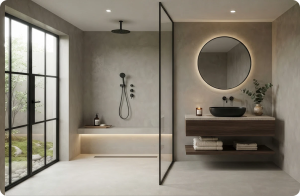
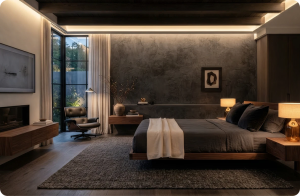


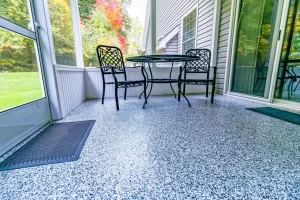

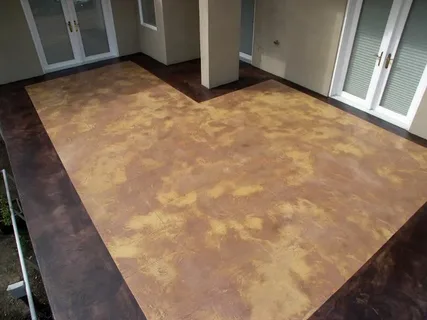
An old concrete floor does not always need to be completely removed to get a new look.
That is one reason homeowners and designers are increasingly interested in a cementitious overlay for concrete floors. Instead of demolishing an existing concrete surface and starting again, an overlay can provide a way to resurface the floor with a new decorative finish when the existing substrate is suitable.
But there is an important distinction between simply covering concrete and properly resurfacing it.
A cementitious overlay is not a magic solution for every damaged floor. The condition of the existing concrete, preparation, moisture, cracks, movement, and the desired final finish all need to be considered before installation.
So when is a cementitious floor overlay actually a good choice?
For the right project, it can provide a practical way to transform an aging concrete surface into a cleaner, smoother, and more contemporary floor without completely rebuilding the space.
Key Takeaways
- A cementitious overlay can resurface an existing concrete floor when the underlying substrate is suitable.
- It can change the appearance of an old floor without necessarily requiring complete concrete replacement.
- Proper preparation is one of the most important factors in the success of a concrete floor overlay.
- Decorative overlays can be designed for different visual goals, from smooth minimalist finishes to more expressive decorative surfaces.
- An overlay is not appropriate for every concrete floor, particularly when there are serious structural or moisture-related problems.
What Is a Cementitious Floor Overlay?
A cementitious floor overlay is a cement-based material system applied over an existing surface to create a new finished floor.
Instead of removing the existing concrete entirely, the overlay becomes the new visible surface.
Depending on the product and application method, overlays can be used to create different appearances, including smooth, refined, textured, or decorative finishes.
This makes them particularly interesting for renovation projects where the existing concrete is structurally usable but visually outdated or no longer fits the design of the space.
The important thing to understand is that the overlay is only as good as the surface beneath it.
An unstable or poorly prepared substrate can create problems regardless of how attractive the finished material looks.
Why Choose a Concrete Floor Overlay?
The biggest appeal is often the ability to change an existing floor without starting from zero.
Imagine a home with an old concrete floor that is structurally sound but has an outdated appearance.
The homeowner may not want the disruption and expense of completely removing the slab.
A concrete floor overlay can potentially provide another option.
Instead of demolition followed by a completely new flooring installation, the existing surface can be evaluated, prepared, and resurfaced with a new decorative system.
That can make an overlay particularly useful for remodeling and renovation projects.
Cementitious Overlay Benefits
There are several reasons homeowners may consider this approach.
Renovation Potential
An existing concrete floor may be transformed rather than completely replaced.
New Design Options
Overlays can create finishes that look substantially different from the original concrete.
Contemporary Appearance
A smooth or refined cement-based finish can complement modern and minimalist interiors.
Flexible Aesthetics
Depending on the system, overlays can support a range of textures, tones, and decorative effects.
Potentially Less Demolition
When the existing substrate is suitable, resurfacing may avoid some of the demolition involved in complete floor replacement.
Design Continuity
A cement-based finish can work with other modern materials such as wood, stone, metal, and plaster.
These cementitious overlay benefits make overlays particularly interesting when the goal is to transform a space while working with an existing concrete substrate.
When Is a Cementitious Overlay a Good Choice?
The condition of the existing concrete is the starting point.
An overlay can be a good option when the existing slab is generally stable and the problems are primarily related to appearance, surface wear, minor imperfections, or the need for a new decorative finish.
For example, an existing concrete floor may be:
- Visually outdated
- Stained
- Worn
- Uneven at the surface level
- Plain or unfinished
- In need of a different color or texture
- Suitable structurally but no longer appropriate for the room’s design
In these situations, resurfacing may offer a practical alternative to complete replacement.
But the word structurally matters.
A decorative overlay should not be used to hide major problems that need to be repaired at the substrate level.
When Should You Avoid a Concrete Overlay?
Not every concrete floor is a good candidate.
If the underlying slab has significant structural movement, severe deterioration, major unresolved moisture issues, or extensive problems that could compromise the new surface, an overlay may not be the right first step.
The same applies to active problems that are likely to continue affecting the substrate.
Putting a new finish over a problem does not make the problem disappear.
That is why professional assessment matters.
Before deciding on a concrete resurfacing overlay, it is important to understand why the existing floor is damaged and whether the underlying conditions can support a new surface.
Concrete Floor Resurfacing Starts With Preparation
One of the biggest mistakes homeowners can make is thinking the decorative material is the main part of the process.
It is not.
Preparation is critical.
The existing concrete generally needs to be clean, stable, and suitably prepared for the particular overlay system.
Depending on the project, preparation may involve addressing surface contamination, repairing certain imperfections, managing cracks, removing unsuitable coatings, and creating the right surface profile for adhesion.
The exact process depends on the condition of the concrete and the overlay system being installed.
The principle is simple:
A beautiful overlay needs a properly prepared foundation.
What Happens During Concrete Floor Preparation?
Every project is different, but surface preparation commonly begins with a detailed inspection.
The existing floor should be evaluated for:
- Cracks
- Surface deterioration
- Contamination
- Previous coatings
- Moisture conditions
- Uneven areas
- Movement
- Weak or damaged sections
Once the condition is understood, unsuitable materials and contaminants can be addressed.
Repairs may be needed in certain areas before the overlay can be installed.
The surface may also need mechanical preparation to provide the appropriate profile for the new material.
The goal is not simply to make the concrete look cleaner.
The goal is to make the surface suitable for the entire overlay system.
Can a Decorative Concrete Overlay Look Modern?
Yes.
A decorative concrete overlay does not have to look like ordinary concrete.
Modern applications can range from understated and smooth to more visibly textured or artistic.
For a minimalist interior, a refined surface with subtle variation can complement the rest of the architecture.
For a more expressive space, decorative techniques can create greater visual movement.
The advantage is that the floor can become part of the overall interior design rather than being treated as a purely functional surface.
This is particularly useful when homeowners want the material itself to contribute to the character of the room.
Smooth Concrete Floor Finish: Why Homeowners Like the Look
A smooth concrete floor finish can create a very clean visual effect.
Without traditional grout joints or busy patterns, the floor can feel more continuous and architectural.
This can work particularly well in:
- Modern homes
- Minimalist interiors
- Open-plan living areas
- Contemporary kitchens
- Dining spaces
- Home offices
- Retail or hospitality-inspired interiors
The simplicity is part of the appeal.
A smooth cement-based floor can provide visual consistency while allowing furniture, artwork, lighting, and architectural details to stand out.
Cement Overlay Flooring for Interior Spaces
Although concrete is often associated with garages, workshops, or exterior spaces, cement overlay flooring can also work in interior environments.
A living room, entryway, kitchen, hallway, or other interior space can use a decorative cement-based surface when the design and substrate are appropriate.
The advantage is that the flooring can connect different areas visually.
For example, a large open-plan space may benefit from a continuous floor treatment rather than separate flooring materials dividing every room.
This can create a stronger sense of flow throughout the interior.
How Does a Cementitious Overlay Compare With Replacing Concrete?
Replacing an entire concrete floor is a much larger construction project.
It can involve demolition, removal of existing material, disposal, new construction, curing, and additional finishing work.
An overlay approaches the problem differently.
Instead of treating the existing floor as something that must be removed, it asks:
Can this surface become the foundation for something new?
When the answer is yes, an overlay can potentially simplify the transformation.
That does not mean an overlay is always cheaper, faster, or easier. Project conditions vary too much for that to be assumed.
But it does provide another strategy for dealing with an existing concrete floor.
Concrete Overlay for Interior Floors: Design Considerations
Choosing the overlay is only one part of the decision.
Homeowners should also think about the rest of the room.
Color
A neutral cement tone can support a minimalist interior, while a warmer or more customized color can work with wood, cabinetry, or other materials.
Texture
Do you want the floor to feel visually quiet or have more movement?
Sheen
The level of reflection can change how the floor interacts with natural and artificial light.
Furniture
A simple floor can provide a strong background for furniture with more color or texture.
Lighting
Large windows, pendant lights, recessed lighting, and wall lighting can all change how the finished surface is perceived.
A flooring decision should therefore be made as part of the overall room design.
Does a Cementitious Overlay Hide Cracks?
This depends on the type and cause of the crack.
A decorative overlay should not be viewed as a universal solution for active structural movement.
Some cracks may be repairable or manageable within the installation system, while others may indicate an underlying issue that must be addressed first.
This distinction is critical.
A homeowner may see a crack as simply a visual defect.
An installer needs to determine whether it is merely cosmetic or evidence of movement or another substrate condition.
That evaluation helps determine whether an overlay is appropriate.
How Durable Is Cementitious Overlay Flooring?
Durability depends on several factors, including the existing substrate, preparation, material system, installation quality, environmental conditions, traffic, and maintenance.
A high-quality installation can be designed for demanding interior applications, but no decorative flooring system should be treated as indestructible.
Daily habits matter.
Heavy impacts, improper cleaning methods, moisture problems, and other conditions can affect the finished surface.
The best approach is to select an appropriate system for the intended use and then maintain it according to the installation and product recommendations.
Cementitious Overlay vs. Traditional Tile
Homeowners considering a renovation may also compare cementitious flooring with tile.
Tile offers familiar advantages, including a wide range of patterns and materials.
A cement-based overlay offers a different visual direction.
Instead of individual pieces divided by grout lines, the floor can appear more continuous.
That can be particularly attractive for homeowners who prefer modern, minimalist, or industrial-inspired interiors.
The decision ultimately comes down to the look, performance requirements, substrate, maintenance expectations, and design goals of the project.
Do This, Not That
Do this: Have the existing concrete evaluated before choosing an overlay.
Not that: Assume any concrete floor can automatically receive a new finish.
Do this: Prioritize surface preparation.
Not that: Treat preparation as a quick cleaning step.
Do this: Address cracks and substrate problems appropriately.
Not that: Use decorative material to hide an unresolved structural issue.
Do this: Choose the finish based on the room’s design.
Not that: Select a finish without considering lighting, furniture, and surrounding materials.
Do this: Maintain the completed surface according to the recommended care routine.
Not that: Assume a decorative overlay requires no maintenance.
Is a Cementitious Overlay Right for Your Home?
A useful way to decide is to start with the existing floor.
Ask five questions:
- Is the concrete stable?
If not, the substrate may need attention before an overlay is considered.
- What is wrong with the current floor?
Is the problem primarily cosmetic, or is there a deeper structural issue?
- What appearance do you want?
Do you want a smooth minimalist finish, decorative movement, or something more distinctive?
- How will the space be used?
Traffic, furniture, moisture, and other conditions can influence the appropriate system.
- Does the new floor fit the overall interior?
A good floor should complement the architecture rather than compete with it.
These questions can help turn a vague idea of “resurfacing the concrete” into a much more realistic renovation plan.
Why Preparation and Craftsmanship Matter
A cementitious overlay may look deceptively simple when finished.
The final floor can appear smooth, minimal, and effortless.
But achieving that appearance involves decisions and workmanship that happen long before the homeowner sees the completed surface.
Surface preparation.
Material selection.
Base layers.
Application technique.
Transitions.
Edges.
Finishing.
Sealing or protection where required.
Each stage contributes to the final result.
That is why the quality of the installation can matter just as much as the material itself.
A good decorative floor is not created simply by spreading cement over concrete.
It is the result of a complete surface system.
Final Thoughts
A cementitious overlay for concrete floors can be a strong choice when an existing concrete surface is stable but needs a new visual direction.
It can offer a way to transform an old floor into a modern, decorative surface without automatically removing the existing concrete.
But the best projects begin with realistic expectations.
An overlay cannot replace proper substrate repair. It cannot eliminate every structural problem. And it should not be selected simply because it looks good in photographs.
The right question is:
“Is my existing concrete a good foundation for the finish I want?”
When the answer is yes, a cementitious floor overlay can turn an ordinary slab into an intentional part of the home’s design.
And that is where the value of decorative concrete resurfacing really comes from—not simply covering an old floor, but creating a new surface that fits the way the space is meant to look and feel.
Frequently Asked Questions
What is a cementitious overlay for concrete floors?
A cementitious overlay is a cement-based surface system applied over an existing floor to create a new finished surface. It can be used for decorative and functional resurfacing when the existing substrate is suitable.
Can you put a cement overlay over existing concrete?
Yes, a cement overlay can be installed over existing concrete when the substrate is appropriately stable, prepared, and suitable for the selected overlay system.
What are the benefits of a cementitious floor overlay?
Potential benefits include transforming an existing surface, creating new decorative options, achieving a more contemporary appearance, and potentially avoiding complete removal of a suitable concrete substrate.
Is a concrete overlay the same as replacing the concrete floor?
No. Replacement involves removing and rebuilding the existing floor, while an overlay uses the existing surface as the foundation for a new finish when conditions allow.
Can a decorative concrete overlay be used indoors?
Yes. Depending on the material system and application, decorative concrete overlays can be used on suitable interior floors such as living spaces, kitchens, hallways, and other areas.
Can a cementitious overlay be smooth?
Yes. Cementitious systems can be used to create smooth, refined finishes as well as other decorative appearances, depending on the selected system and application technique.
Will a cement overlay cover cracks?
It depends on the type and cause of the crack. Some cracks may be treated as part of preparation, while active movement or serious substrate problems may require a different solution.
How important is concrete floor preparation?
Preparation is extremely important. The existing surface needs to be appropriately clean, stable, and prepared so the overlay can bond and perform as intended.
Is cementitious overlay flooring durable?
Durability depends on the substrate, preparation, materials, installation quality, environment, traffic, and maintenance. The appropriate system should be selected according to how the floor will be used.
How do I know whether my concrete floor is suitable for an overlay?
The best way is to have the existing surface evaluated for stability, cracks, moisture, contamination, previous coatings, surface condition, and other factors that could affect the installation.
Is a cementitious overlay good for a modern interior?
It can be an excellent design option for modern interiors, particularly when homeowners want a continuous, smooth, understated, or contemporary flooring appearance.
Does a concrete overlay require maintenance?
Like other finished flooring systems, an overlay should be cleaned and maintained according to the recommendations for the specific system. Proper care can help preserve the appearance and performance of the finished surface.